Friday, July 15, 2011

Conan is my Green Lantern, maybe.

Disclaimer: there is no movie talk in what follows.

One of the oft repeated rubrics by which the quality of super hero games is measured is what I'll call The Green Lantern Test. Many consider the ability to adequately model the Green Lantern a key indicator of a SHRPG's flexibility. The thinking is, of course, if the game can allow you to create a playable GL, it can likely do just about anything else you need it to in terms of character generation. In the universal sense, it's not a perfect test. For example I'm fairly certain that one could adequately model GL in Mutants or Masterminds, but, given my limited intellect, I would still find it unplayable. However, if one likes the game play of a certain system and it can model GL, chances are (keeping in mind no game is perfect all the time) it will facilitate a benign SHRPG experience.

When it comes to Sword and Sorcery or Science Fantasy RPGs, GL's role is perhaps most properly assigned to Conan. Conan is at various points in his a career, a warrior, a thief, a sailor, a bandit a forager in the wilderness and many other things. Class and level based games have, by and large, two distinct ways of dealing with Conan.

The easiest method, at least in terms of book keeping, is best exhibited by OD&D 1974. Essentially everyone is either a Fighting Man or a Magic User, and the actions of players outside of their two main oeuvres are constrained only by the imagination of the player, the ruling of the referee, and the parameters within which the group can collectively suspend disbelief. As a referee I am perfectly content with this system. In my experience, players, however, like to have options. They want their adventurers to differ from one another. Occasionally, despite, the repugnance of it all, a conscientious referee must take the wishes and desires of players in to account.

This leads us, as it did the earliest formulators of the game and their successors, to the second method, found in the supplements of OD&D and every iteration of the game released henceforth: a proliferation of character classes, e.g., Thief, Fighter, Ranger, the noisome Cleric, and so on. Many of these classes model one or another part of Conan's career, and, quite obviously, go well beyond its boundaries. None of theses classes, however, adequately model Conan's entire career.

I would find this frustrating enough if the problem stopped with Conan. It does not. What if someone wishes to play a character very much like the Grey Mouser? What class should the select? The facile answer is, of course, under 1e rules, a simple Thief. I would have to disagree, though; Thieves do not fight so well as Fighters, and I never felt that the Mouser was any less of a swordsman than Fafherd or, Conan, for that matter. What if a player wants to emulate Severian from the Book of the New Sun or that Beast Master guy from that 80's movie of the same name?

Setting aside the straight OD&D option for the reasons mentioned above, how can this problem be solved, without resorting to the semi-solution of cumbersome and fiddly multi-classing? Furthermore, as has been pointed out by others, as soon as an ability (e.g. pick pockets) is given to a specific class, it is more or less taken away from the other classes.

I submit, therefore that the proliferation of character classes is an inadequate solution to the Conan/Grey Mouser/Severian problem, and, furthermore, as a phenomenon, introduces more problems to the game than it solves.

These problems have stalled my own design efforts, bringing me, in reality to a dead stop for the last couple of months.

Yesterday, I cracked the code (to my own satisfaction, anyway).

Before you continue, keep in mind that I still view OD&D 1974 (or S&W Whitebox) as nearly perfect just the way they are (the way they are practically necessitates house rules, but that's another conversation, altogether) and all my Metal Earth rule modification are modular, and any adventure material I create, or have created, can be used with the additions or without them.

The admittedly nascent system proposed below is linked to some of my earlier ideas, namely saving throw based task resolution. If you don't want to read about the stuff, just keep in mind that I use a simple system of saving throws and modifiers for non-combat task resolution. Just by reading that sentence you have been introduced to about 90% of that system.

The Fighting-man class has been, in my Metal Earth game, replaced by the Adventurer class. Other classes will be the Sorcerer, and, possibly the Mastermind.

I know it's unseemly to beg, but some comments on anything you've read here today, would be smashing .

Anyway, here it is:

The Adventurer

A member of the Adventurer class can be a Wanderer, warrior, thief, sailor, soldier or, at one time or another, all of the above and more. The ability to survive lies at the core of this class.

At first level and every 2 (3rd, 5th, 7th) levels thereafter the members of the adventurer class may select one competency from the list below. For the purpose of skill advancement, the level at which the character picks a competency is treated as first level when calculating modifiers. For example if Kronark the Barbarian selects the thief competency at 5th level, this level is considered first level when calculating all die rolls).


Offensive fighter: Offensive fighters gain +1 to attack rolls and a +1 to all damage rolls- including results on critical hits tables.


Defensive fighters: Defensive Fighters gain a +1 to their AC (unless taken by surprise) and a +2 to all saving throws vs. wounds/critical hits.


Badass: A Badass character can deal lethal damage (including critical hits) and receives a +1 to hit with unarmed attacks.


Advanced Badass: (Prerequisite, Badass or Defensive Fighter): An advanced Badass has an automatic 4 [15] AC (against melee based attacks) without armor.


Survival: Characters with the survival competency gain a +2/level to all survival related task resolution saving throws, including foraging and overland navigation.


Sailing: A sailor knows how to handle themselves aboard a ship. This includes competency at basic ship board tasks, such as getting under way and stowing cargo, and setting sail as well as more advanced tasks such as navigation.


Thief Skills: A character with the thief skills is adept at such activities as picking locks, climbing walls, and picking pockets. The character receives an initial +2 and +1/lvel to all task related saving throws whilst using these skills.


Marksman: A marksmen receives a +1 bonus to hit and to damage with firearms (including critical hits at close range).


Torture: Character that have been schooled in the art and science of torture receive a +2 per level on all interrogation based saving throws.


Art: An artist is especially skilled at some sort of creative expression. While in a city performers musicians, dancers, jugglers can earn 1d20 Zorms a week. If they are left to depend upon their creativity for sustenance, other artists will almost certainly go hungry, unless they can somehow arrange for a wealthy patron to subsidize their lifestyle.


Beast Mastery: A beast master has way with animals and can effectively charm Lvl +2 hit dice worth of creatures.


Keep in mind these are just samples, and the players and referee can easily create their own sets of abilities.

Thursday, July 14, 2011

Skeletal Warrior (Player Character Version)


Skeletal Warrior (Player Character Version)

STR* 3D6

INT 3D6

DEX* 3D6

CON* 3D6

WIS 3D6

CHA 1D6


Skeletal Warriors, or the Half-dead as they are sometime called, were created during the course of a war lost in the Mists. At one time there were vast numbers of these creatures, but in these latter days there numbers have dwindled. Most of the Half-dead are mindless undead automatons, usually employed by a renegade Shae Sorcerer or a group like the Changers. Player character Skeletal Warriors are among the few that have spontaneously gained self-awareness. Some are haunted by hazy memories of their first life, before they were raised; many have no recollection of anything aside from their days as undead warriors. Due to the fragility of bone structure in the extremities, the hands of feet of Skeleton warriors are made from a compound of bone, necrotic flesh and enchanted stone.


Special: Skeletal Warriors have 2d6 to apply to their physical attributes (STR, CON, DEX). Skeletal Warriors do not require food or drink, but must bask in the light of the full moon for one full night every month in order to replenish their power. If two months are missed in succession the Skeletal Warrior temporarily looses 1d6 from all attribute scores. If the Skeletal Warriors passes two months without basking in the moonlight, they lapse in to a dormant state until they are exposed to the full moon for three consecutive months, at which time they wake. They must make a saving throw to retain memories and experience levels. If they fail, they revert to first level. Skeletal Warriors are immune to poison and receive a +2 to all saving throw.


Shit drawing provided free of charge. Click to enlarge- if you dare.

Wednesday, July 13, 2011

Burnout, thoughts on comics, two weapon fighting, Helltoad, and so on


Well, it appears to be fading now, but sometime in May, I experienced a bit of RPG burnout. I still managed to keep my semi-weekly ICONS game afloat, but I kind of lost interest in doing any more than that. I think if I hadn't felt obligated to my players I would have canceled that too. I stewed for a week or so and then I started to focus my energy in a different direction. I allowed myself to become consumed by comics. I read some current Marvel and DC for a few weeks, but they quickly lost my interest. It's true that Infinite Crisis, The Sinestro Corps War and Final Crisis we're kind of cool as was Annihilation; ultimately, though, all these series, and several others I sampled were hampered by the need to tie into current continuity.
However, I got the big Jack Kirby Captain America Omnibus and the BPRD Plague of Frogs Hardcover for my Birthday; additionally i received The Walt Simonson Thor Omnibus for Father's Day. The first two are, of course, excellent; the third, however, pictured at the right, is the best 80$ you will ever spend on entertainment. It is over 1200 pages of cosmic ass kicking, it opens with the Ballad of Beta Ray Bill and covers Simonson's entire run on the title (some 42 issues). One of my favorite things about it is that it has been completely recolored. The new colors really compliment Simonson's artwork, imo.

Well enough of that:

Two weapon Fighting:
At fourth level members of the Adventurer class can chose to fight with two melee weapons in lieu of using a shield. upon rolling a successful attack roll the player rolls two D6, the higher result represents the damage done by the combined attack. Two weapon fighter score a critical hit on a 19 or a 20. All other critical hit rules apply.

Hell Toad
Spell level: Sorcerer 3
Range: 240 feet
Duration: Instantaneous
Upon casting this spell the Sorcerer distends his jaw and vomits forth a 45 foot cone of screaming, burning, ravenous toads. The cone is roughly 10 feet wide at its base. Damge is 1d6/lvel of the Sorcerer. A successful saving throw results in half damage.


Anyway, I'm moving back to Denver next month and that means more FtF gaming and more play testing. So The Metal Earth Project is moving forward. The main slowdown right now is due to the fact that I'm trying to write up all the spells and I suck at that. My other major project right now is, for lack of a better term, a graphic novel. I've been thinking about it for years and actively working on it for a couple of weeks. I'll be moving in to my fourth page of artwork (I'm guessing it will be around 150 pages long) tonight. I have two main goals with this project: to improve my cartooning skills and to tell the kind of goofy cosmic super hero story I'd like to read. At the top of this post and below you can find Two pics (click to enlarge) of the main character, Doc Vulcan. Up top, he is transforming, below he is doing super guys do- or perhaps he is performing a dramatic reenactment of the last week or so of activity in the OSR blogsphere- you make the call. I'll also be using several public domain supers in the story. When I get about 50 pages done, I'm going to start posting it as a web comic.

Tuesday, May 17, 2011

Carry Me Home to the Fire

The undead are a tremendous problem in The Metal Earth. The magical and technological detritus of a thousand, thousand different vanished civilizations have created a world in which a corpse can rise up to terrorize the living in any number of different ways. Coming back from the dead, or rising, as it is popularly called is one of the greatest fears of the age.

This problem is primarily addressed through the near universal mortuary practice of cremation. However, people don't always die at home or even within the confines of the cities.
For most sentients it is nearly unthinkable to allow a loved one to face the possibility of risings and families will often impoverish or even bankrupt themselves to make certain that a relative's corpse is recovered and carried home for burning.

Rates charged for corpse recovery vary from place to place; 500gp is usually the starting price for any such expedition; sometimes if the body has been lost in an especially dangerous region the price can exceed ten times this amount.

Obviously, corpse recovery can provide opportunity for adventurers looking to earn a little (or a lot of) coin. However, aside from the risk inherent in travel outside the cities, there is also a social stigma. Corpse handling is seen as the lowest sort of task and those that engaged in recovery may find themselves unable to spend their coin in respectable establishments as they will have been relegated to the lowest caste of society- the Burners, perhaps the only group seen to be less desirable than humans (although not nearly as subject to hate motivated violence).

Special thanks to Boulet at the therpghaven.

Wednesday, May 11, 2011

Space D&D & using other people's material

Right now, if I were going to add an outer space element to my Metal Earth home game, space craft rules would be handled by a combination of Spelljammer and XXVc; earth would be the Metal Earth, Mars would be Athas (Dark sun), Venus would be Carcosa or Athanor and counter earth would be Planet Algol.

Sunday, May 8, 2011

XXCv: What is in the box


So as stated in my previous post, I picked up a copy of Buck Rogers XXVc last weekend. I have vague memories of seeing this game when it was released, but I wasn't sure why I never picked up a copy at the time. I have always been mad for this kind of thing. As it turns out, the game was released in 1990, arguably the craziest year of my entire life (although the years that bracket it are also fair contenders for this title). Furthermore, I think I may have been put off of TSR product by this point for some bullshit early 20's reason or another.

I've flipped through all three books, and I'm about a third of the way through an in depth read of the first book. My initial impressions are extremely positive. The rules are AD&D based- an obvious bonus. Additionally, I'm a huge fan of Solar System SF and that is what this game is all about. I'm pretty sure I could tweak the rules for this game to emulate the settings from books like EE Smith's Space hounds of the IPCC, Bester's The Stars My Destination, Larry Niven's early Known Space stuff, and dozens of other things that I'm too lazy to type the titles of- or my own custom Solar System setting.

Anyway, onto the unboxing pics!


All these photos are crap. I can't cipher how to adjust the white balance on my camera, and my secret undersea base seems to be a less than ideal environment for taking pictures. Furthermore, autofocus sucks. I will be happy to rephotograph anything that anyone would like a better look at.
You can click on all these if you desire a larger/blurrier version.

Anyway...

First up the box. It is big and thick.

And it has a lot of stuff in it:
There are three books:

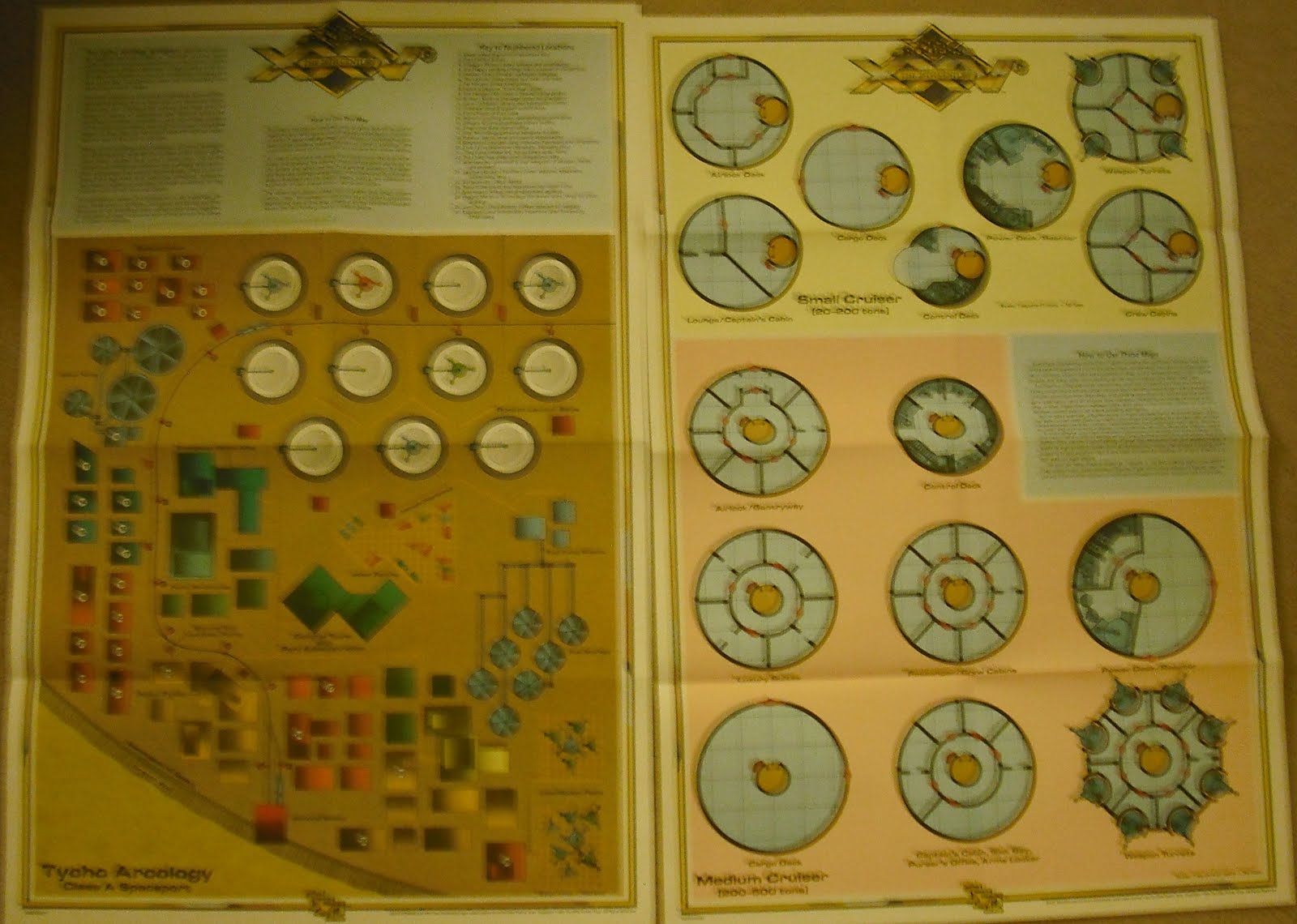
Two big ass reversible poster maps:

Counters and a (flimsy) three panel referee screen.

Several 8 x 11 planet map/stat (map on one side, stats on the other) cards.

A bunch of ship cards of the same size.
And this thing, which appears to be some sort of game aid designed to help with figuring out interplanetary travel time, fuel requirements and other junk.


Well, I have to say that all of this creates quiet an out of the box experience. It is a really nice assortment of stuff. I am not certain, however, how much table time some of the ship cards and what not would actually get. I'd have to give the game a spin in order to know that.

Playtest, Buck Rogers XXVc and some drawings


My best friend Scott and I did a long playtest (about 6 hours) of The Metal Earth rules during my visit to Denver last weekend. The entire thing was completely spontaneous. Scott ran three player characters: two adventurers (a minotaur and a grey) and a shae Sorcerer, who was the leader of the expedition and in search of magical treasure. Anyway, the party explored the Tower of The Changer * in its entirety and made their way down into the Forgotten Depths* wherein the party found a teleportation pool (Hex 0703) that led back to the city of Ssaur *. We tried out new spells, several of the character generation options, combat and some other junk. It went very well, and there is nothing like running a game with the rules scattered across a couple of books and several sheets of note paper to help one get an idea of how to put together a final product.
So the work continues, although I now have a complete outline and a good deal of almost every chapter written.

*Available for free on the left.

The other awesome thing that happened: I picked up a copy of the Buck Rogers XXVc game. I missed this game when it was released and I've been curious about it ever since- to the point that along with Gamma World 1e it is on my short list of games that I will purchase on sight.
As far as my copy goes, the box is worn, but it really doesn't look like anyone ever opened the game books and all the chits are still in place. Beyond that, If anyone is interested I could probably be talked into doing a more thorough review of the thing.

In other news, I can't say why, but the online gaming world is kind of bringing me down lately. I've given up on forums completely and sadly some blogs. I'd point out what bothers me (it's not politics, btw) but then I'd have to suffer through comments where people tell me stuff we ALL already know (i.e. people can post what they want on their blogs).

Here's some "Art" click on the images for larger versions.

This one I've posted before, but this is a much better scan:
Here are the PCs from my ICONS game Doc Crucible (left) and The Fire Knight (right):
And some rushed drawings of next week's villains (The Round Up Gang):

Whiplash McKracken


The Texas Skull
And Little Lady Lariat
Theses guys are bounty hunters who are hunting down the PCs (who have been accused of being Soviet collaborators [the game takes place in 1950]) There are a couple more of this crew: Kid Snake Eye and Pappy (think like the Hulk, but a redneck feller); I haven't gotten around to drawing them yet.